Static and Mobile Distributed Energy Storage – We Drive the Wind
Author: Jim
Jim is a very experienced electronic engineer and embedded software developer, and is a Member of the Institution of Engineering and Technology.
He has represented the BSI on international electricity grid standards development committees since 2013 (IEC TC57), plus electric vehicle (EV) standards committees since 2017 (IEC TC69 & ISO TC22/SC31). Jim is also a member of the IEC System Committee on Smart Energy and the BSI's L/13 "Smart Energy Systems coordination group" mirror committee where he is the "UK Expert -- Vehicle 2 Grid (V2G)".
His Majesty’s Government has published another press release about plug-in solar panels! On this occasion all the Government’s bullet points are of interest to the team here at Distributed Energy Storage Ltd:
● B&Q and Currys join government plans to bring plug-in solar to UK homes
● Rooftop solar panels are already saving families up to £480 a year
● Government launches consultation for industry views on ensuring consumer safety
Below the bullets we discover that:
More families are set to save money on bills as flagship retailers Currys, B&Q, Amazon and Lidl join government plans to bring plug-in solar panels to UK homes.
At a roundtable of some of the biggest retailers in the country, with a combined total of almost four thousand stores and significant online presence, Minister for Energy Consumers Martin McCluskey discussed the crucial role of plug-in solar in the clean energy revolution.
Those in attendance included Amazon, Asda, B&Q, Currys, Screwfix and Wickes, who discussed the technology and how it can offer a cheaper route for people to save money on bills.
This follows rule changes announced by the government earlier this year that will allow UK homeowners to self-install plug-in solar panels in the coming months and builds on savings of up to £480 consumers can already make from rooftop panels.
Minister for Energy Consumers Martin McCluskey said:
“Plug-in panels can be transformative for renters or those on lower incomes, so I welcome the conversation today with household names such as B&Q and Currys showing a huge amount of support for getting the panels in people’s homes.
This easy to install tech can cut people’s bills and help make the UK less reliant on global fossil fuel markets.”
This time around the accompanying short video is hosted by Katie White OBE MP, Minister for Climate in the Department for Energy Security and Net Zero, instead of Martin:
More information about the “consultation for industry views on ensuring consumer safety” can be found in a separate Government announcement:
We are proposing changes to the Plugs and Sockets etc. (Safety) Regulations 1994 (PSSR). The aim is to allow consumers to connect plug-in solar systems (without batteries) directly to a standard mains socket, provided products meet defined safety requirements. This would represent a new, accessible route for households to generate clean electricity, helping reduce energy bills, and supporting wider clean power objectives.
Alongside regulatory changes, DESNZ is also proposing an interim product specification to ensure that only safe and compliant products can be placed on the UK market during a transitional period, while enduring standards are developed.
Regen provides independent, evidence-led insight and advice in support of our mission to transform the UK’s energy system for a net zero future. We focus on analysing the systemic challenges of decarbonising power, heat and transport. We know that a transformation of this scale will require engaging the whole of society in a just transition.
Plug-in batteries could significantly reduce household electricity bills, particularly for renters, flat dwellers and low-income households, who are largely excluded from installing traditional home battery systems today. The government has already announced regulation changes to make plug-in solar panels available as part of its response to the rise in energy costs caused by the US war with Iran. In this blog, Regen argues they should go one step further and make standalone plug-in batteries available too.
Rooftop solar and home battery systems are a well-established pillar of the government’s net zero and energy security strategy. But to date, systems that can be plugged into a regular wall socket have not been legal in Great Britain. This is in stark contrast to mainland Europe, where plug-in systems are commonplace and can be bought off the shelf from Ikea or Lidl.
Plug-in solar has been available for almost a decade in Germany, where there are now more than a million systems in place. In March this year, the UK government announced regulation changes to make plug-in solar panels available ‘within months’, as part of its response to the rise in energy costs caused by the US war in Iran. However, the announcement was noticeably quiet on plug-in batteries.
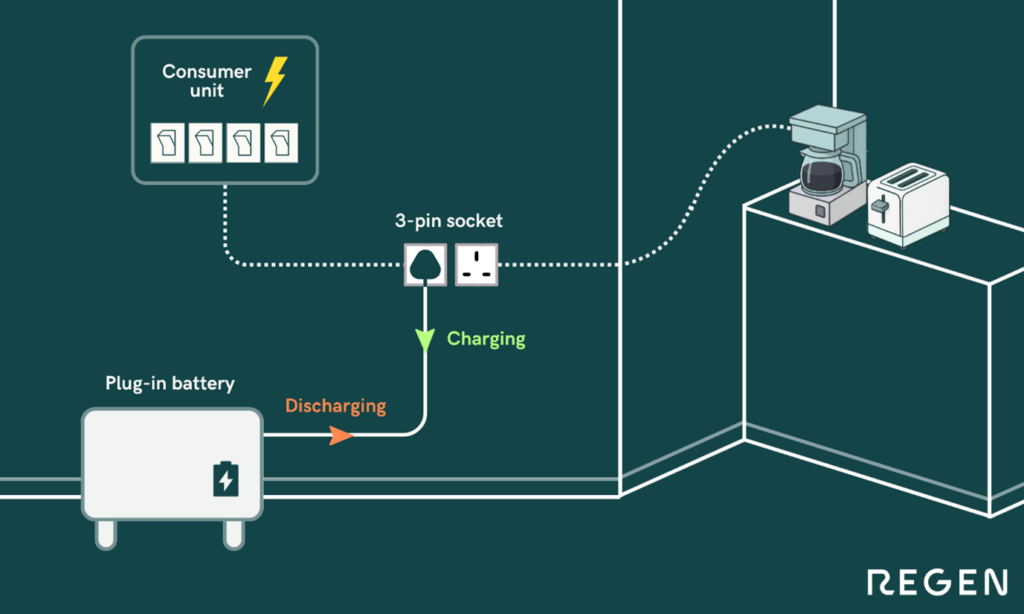
A plug-in battery is a portable energy storage unit that can be plugged into a standard wall socket without any modification to the household wiring. It charges by drawing electricity through the socket – typically during the off-peak period of a time-of-use tariff – and discharges back through the same socket to offset household demand at times when electricity is more expensive.
Unlike traditional domestic battery systems, which must be hardwired into the home’s electrical system by a qualified electrician, plug-in batteries can be bought off the shelf and plugged into a wall socket like any other household appliance:
Infographic: Regen
Please read the entire article, but here’s the Regen team’s conclusion:
It’s clear that plug-in batteries could be transformational for households in Great Britain that to date have been excluded from the benefits of home batteries. It’s positive that the government has announced plug-in solar, but it has left plug-in batteries in a grey area.
Regen suggests that DESNZ should now:
● Commit to a date by which plug-in batteries will be legally available for use in Great Britain
● Commission a rapid safety study for plug-in batteries, and work with the IET and BSI to update BS 7671 (the UK wiring regulations) accordingly
● Sponsor a new product safety standard through BSI for battery fire safety in portable in-home devices (distinct from the PAS 63100 framework written for installed systems).
With the government commitment to cutting £300 from household energy bills looking increasingly out of reach, introducing a new product to the market that delivers meaningful bill savings at no cost to the Treasury should be one of the easier calls to make.
British Summer Time has just begun, and in anticipation of the auspicious event His Majesty’s Government issued a long overdue press release last week. The initial bullet points of greatest interest to the team here at DES Ltd. read as follows:
‘Plug-in’ solar panels to be in shops within months, offering households chance to significantly cut energy bills
New rules introduced today to ensure majority of new homes in England will come with solar panels fitted as standard
Regarding the first bullet, the Government has this to say:
Today, the government is driving forward with the rollout of “plug-in” solar panels (low-cost panels that families can put on their balconies or outdoor space) to be available in shops within months and save people money on their bills.
Retailers like Lidl and Iceland, alongside manufacturers such as EcoFlow, are working with government to enable them to be brought to the UK market.
Plug-in solar is already widely used by households across Europe, with Germany seeing around half a million new devices plugged in per year. The free solar power can be used directly through a mains socket like any other device, without an installation cost, thereby reducing the amount of electricity taken from the grid and cutting energy bills.
The easy-to-install technology could save many households significant amounts on their energy bills and help make the UK less reliant on global fossil fuel markets.
The Department for Energy Security and Net Zero has even produced a YouTube short video. Michael Shanks MP, Minister for Energy, explains that:
This doesn’t replace the grid, but it’s a smart source of extra power for your home, and it’s about time we had them here in the UK! Last year alone, in Germany, more than half a million of these were plugged in.
When do you suppose it will be possible to actually purchase such “easy-to-install technology” in “the middle of Lidl” in the UK? The moment cannot come soon enough!
Moving on to our second bullet, the press release adds:
The government has taken decisive action in response to the conflict in the Middle East to fight for consumers and businesses on the cost of living, and is speeding up plans for more clean, homegrown energy that the UK controls to ensure energy sovereignty and security.
This is alongside new rules coming into force today implementing the Future Homes Standard, which includes common-sense measures to ensure the majority of new homes are built cheaper to run, with solar panels and clean heating as standard.
Isn’t it a shame that David Cameron’s Conservative Government pulled the plug on the previous Labour Government’s “Zero Carbon Homes” initiative way back in 2015?
Ed Miliband has been busy recently. Following last week’s policy paper about the benefits of onshore wind, the United Kingdom’s Secretary of State for Energy Security and Net Zero has provided the foreword to this week’s “summer update” of the ongoing “Review of Electricity Market Arrangements”:
Our mission to make Britain a clean energy superpower is about getting off expensive, insecure fossil fuels controlled by petrostates and dictators, and replacing it with clean homegrown energy that we control. It presents a huge opportunity to boost our energy security, protect consumers, create jobs, and drive growth, while tackling the climate crisis.
To deliver this mission, we must ensure that our electricity market arrangements are fit for the future. The Review of Electricity Market Arrangements (REMA) Programme was set up in 2022 to consider how best to deliver a fair, affordable and secure power system. It has been supercharged by this government’s clean energy superpower mission, delivering clean power by 2030 and accelerating to net zero across the economy.
This document sets out the outcome of that review, and our plans to create a more coordinated and strategically planned electricity system. This will give certainty to investors and ensure future electricity generation in Great Britain delivers the best value for consumers. We have decided to retain a single national GB-wide wholesale market and introduce an ambitious package of reform to improve the efficiency of our future power system. We have therefore decided not to implement zonal pricing.
These decisions will lay the foundation for a fair, affordable, secure and efficient electricity market. I would like to thank all the stakeholders across the energy sector who have worked with us during REMA. Delivering substantial and radical improvements in a national model will require continued collaboration between government including Ofgem and the National Energy System Operator (NESO), and stakeholders across the energy sector, and we will set out our detailed plans later this year.
This is a decisive step forward that lays the foundation for cheaper, more secure, and clean homegrown power for homes and businesses across Britain.
There are some who quibble with Ed’s “decisive step forward” assertion, including yours truly! By way of some background, here’s The Economist back in March:
When campaigning for office Labour named five priorities, from kickstarting economic growth to halving serious violent crime. Progress has been patchy, at best. But on one of its five “missions”, making Britain a clean-energy “superpower”, there is some cheerful news. In 2024, for the first time, renewable energy (mainly wind and solar power) generated most of Britain’s electricity.
In addition to providing environmental benefits, renewables are supposed to help cut utility bills, because they generate electricity much more cheaply than gas power stations, Britain’s main source since the 1990s. The secretary of state for energy, Ed Miliband, stresses that renewable energy is “desirable, because it can lead to cheaper, more secure electricity”.
But there is little evidence that renewables are making electricity cheaper.
Next let’s go back even further. Here’s an extract from the foreword to a 2023 report “commissioned by Innovate UK” entitled “Enabling Decentralised Energy Innovation“:
There is growing evidence of the potential benefits of integrated place-based approaches. They could bring cheaper energy for consumers, build local prosperity, accelerate the journey to net zero through progress in towns and regions around the country, and mitigate the massive costs of reinforcing energy networks that will otherwise be needed.
But we have also learnt that there are many barriers in the way of large-scale roll-out of decentralised energy systems, including questions of regulation and governance.
Putting our trusty time machine into reverse, here the start of the summary to the “Reforming our electricity markets” section of His Majesty’s Government’s “Clean Power 2030 Action Plan“, published in December 2024:
Delivering Clean Power by 2030 requires an ambitious and actively planned approach from both government and business. Action is needed to shape and enable effective markets. This approach is central to the development and operation of the 2030 system and will only grow in importance as the system becomes more distributed and flexible in 2030 and beyond.
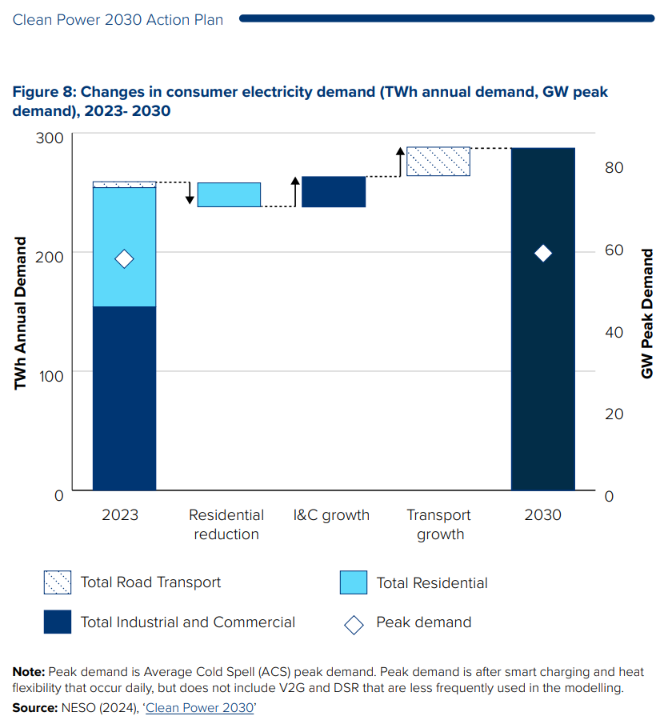
Here’s Figure 8 from the “Action Plan”. Note the small print that states “Peak demand is after smart charging and heat flexibility that occur daily, but does not include V2G and DSR that are less frequently used in [NESO’s] modelling.”
According to Ed Milband’s foreword to the same report:
Since Russia’s invasion of Ukraine, Britain has experienced a devastating cost of living crisis caused by our exposure to volatile fossil fuel markets. Every family and business in the country has paid the price and we remain exposed to future energy shocks. In an increasingly unstable world, our dependence on fossil fuels leaves us deeply vulnerable as a country – and that is true no matter where they come from.
But there is a solution: by sprinting to clean, homegrown energy, we can take back control from the dictators and the petrostates. That is why the Prime Minister has put delivering clean power by 2030 at the heart of one of his five missions and Plan for Change.
The age of clean electricity is about harnessing the power of Britain’s natural resources so we can protect working people from the ravages of global energy markets. This plan will provide the foundation for the U K to build an energy system that can bring down bills for households and businesses for good. And it is also about creating the sort of country that we know people want to see, reindustrialising our heartlands with good jobs and tackling the climate crisis.
Would it surprise you to discover that the 2025 REMA summer update makes no mention of the words “decentralised” or “distributed”? Or the phrase “vehicle to grid”?
However, it does include this statement:
Together with NESO and Ofgem we are continuing to consider:
Shortening the imbalance settlement period to 15 or 5 minutes: Shortening the settlement period duration from the current 30 minutes would create a more ‘granular’ wholesale market temporal signal. It could lead to greater market participation by smaller and innovative flexible assets that are very responsive, including demand-side response and battery storage.
How long do you suppose the Government’s continuing consideration will take?
In a policy paper announced earlier today His Majesty’s Government has published the final report of its Onshore Wind Taskforce. According to Ed Miliband, Secretary of State for Energy Security and Net Zero:
It sets out more than 40 steps government and industry will take to help deliver up to 29GW of onshore wind by 2030. That includes driving ambitious reforms to planning, grid connections, and routes to market, while building the supply chains and skilled workforce we need.
As part of this, we will consult on how permitted development rights can support the rollout of small-scale onshore wind and repowering. Great British Energy, our publicly owned energy company, will invest in and develop renewables projects. And we will work with the Ministry of Defence to take a mission-driven approach to addressing issues relating to wind turbines and defence infrastructure, which have slowed down deployment in the past.
According to the Executive Summary of the report:
Under this Government we removed the defacto ban on onshore wind in England, and are delivering radical action to unlock 27-29GW of onshore wind by 2030 across GB. That’s around 10-12GW more than would have been deployed under historic growth rates, with England contributing around 2GW by 2030.
Onshore wind is among the cheapest sources of new electricity generation to build and operate at scale. Scaling up home-grown renewables, like we’re doing for onshore wind, reduces the UK’s exposure to volatile global fossil fuel prices, which protects consumer energy bills against future price shocks.
In the depths of the report Action Item 14 mentions energy storage:
The Strategic Spatial Energy Plan (SSEP) will support a more actively planned approach to energy infrastructure across England, Scotland and Wales, land and sea between 2030 to 2050. It will do this by assessing and identifying the optimal locations, quantities and types of energy infrastructure required for generation and storage, including onshore wind, to meet our future energy demand with the clean, affordable and secure supply that we need.
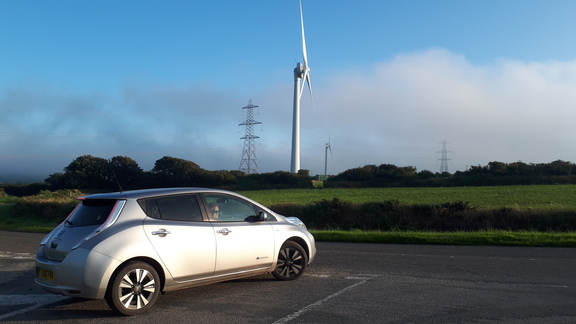
Lisa the LEAF cannot contain her excitement at the news!
She cannot wait to drive up to Westminster to explain to Ed et al. the potential benefits of rolling out mobile distributed energy storage in conjunction with the promised renewable energy generation. In other words, lots and lots of bidirectional electric vehicles connected to an even greater number of bidirectional EV charging stations!
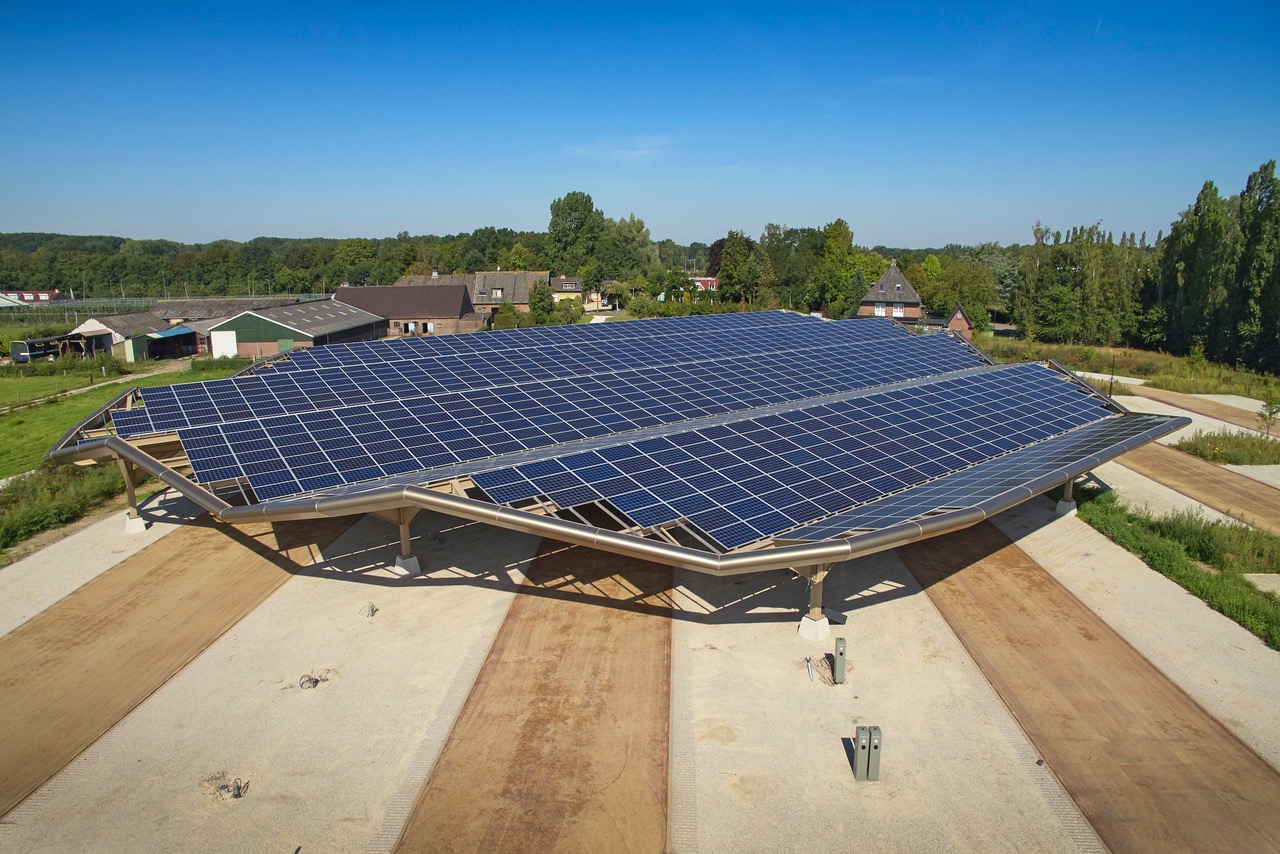
Many of which could be installed in car parks, under a canopy of solar PV panels. Here’s one the Netherlands invented earlier:
In a press release yesterday Torridge District Council announced that:
It has appointed BAM Construction to act as the main contractor for the delivery of the Appledore Clean Maritime Innovation Centre. The Centre has been partly funded through the Levelling Up Fund, Community Regeneration Partnership and funding from the UK Government as part of the Devon and Torbay Devolution Deal, managed by Devon County Council.
Torridge District Council has been working with BAM to progress and finalise the designs for the Centre, which will include workshops, offices and collaboration space together with parking facilities and improved access to the slipway. The Centre is expected to be completed in 2026.
Initial works will involve making improvements to the wall adjoining New Quay Street before works to construct the building commence in the Autumn. Early enabling works to deliver a new quay to provide improved access for users of the building to the estuary, commenced onsite in April. A kind spring has allowed the project to progress at pace.
BAM Construction is looking to use local contractors and businesses wherever possible. In October, a ‘Meet the Buyer’ event was held in Appledore in October 2024. Since then, several local suppliers have joined the project’s supply chain and will contribute during the main construction phase. The team continues to engage with local businesses to ensure opportunities remain accessible throughout the build.
Councillor Ken James, Leader of Torridge District Council, commented:
This is a very exciting step in the journey of this project, not just for Appledore, but for the wider district. We hope that the delivery of this centre will put Appledore and Torridge at the forefront of innovation and investment in clean maritime energy. By getting as many local trades people involved in the build as possible, we hope that this will be just the start of future job creation and investment in the area.
Our local Member of Parliament, the Rt. Hon. Sir Geoffrey Cox KC, MP for Torridge and Tavistock, added:
I am delighted to see the rapid progress being made in realising the ambition of the Levelling Up Partnership (now rebadged the Community Regeneration Partnership) awarded to Torridge by the last Government, which is to invest in communities like ours that have missed out on public investment over many years. The £15.6 million invested by the last Government into this Maritime Innovation Centre, and the allocation of millions more into projects such as the Holsworthy Agri-Business Hub, Bideford’s Pannier Market, Business Park and Hospital, and the Globe and Hatchmoor Industrial Estate in Torrington, will create new opportunities for our young people and boost our economy. I congratulate Torridge District Council, and all those involved, for their good work so far in realising these aims.
In a press release earlier today the United Kingdom’s “Energy System Catapult” announced that:
The Electrification of Heat (EoH) demonstration project, funded by the Department for Business, Energy and Industrial Strategy (BEIS), is seeking to better understand the technical and practical feasibility of a large-scale rollout of heat pumps into existing British homes.
From Victorian mid-terraces to pre-WWII semis and a 1960s block of flats – the project has proven that heat pumps can be successfully installed in homes from every style and era…
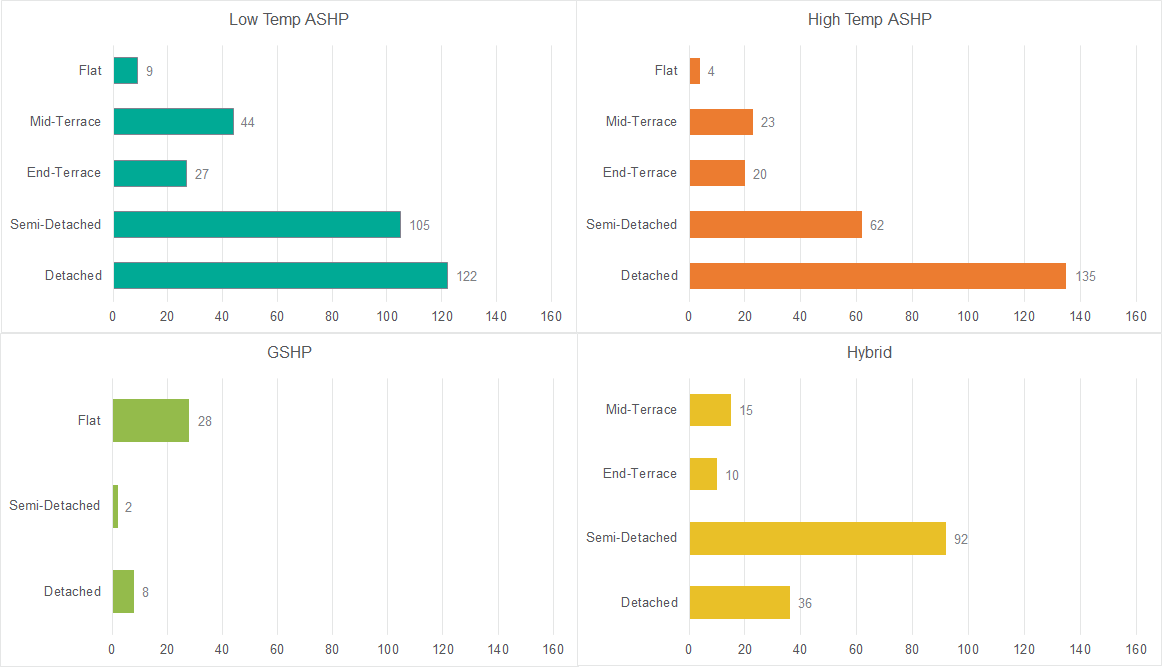
The recruitment and installation phase of the EoH project ran from July 2020 through to October 2021, and despite the challenges of the Covid-19 pandemic, 742 heat pumps were installed into a broad spectrum of housing types and socio-economic groups, that reflects a representative sample of households across Great Britain.
The range of different heat pump installed, included:
Low-temperature and high-temperature air-source heat pumps
Ground-source heat pumps
Hybrid heat pumps incorporated with a gas boiler
some additional technologies, such as heat batteries were incorporated.
“Heat batteries” sounds a lot like “distributed energy storage” to us! However the EoH installation breakdown doesn’t seem to reveal how many heat storage devices have been deployed so far:
The press release continues:
Energy and Clean Growth Minister, Lord Callanan, said:
“Heat pumps powered by clean, renewable energy will be key to warming UK homes in a net zero future.
“This trial demonstrates that low-carbon heating systems are an effective alternative for homes of all types and ages. As technology continues to improve and costs plummet over the next decade, they will become the obvious, affordable choice for consumers.”
Hear, hear! And what is more:
Richard Halsey, Capabilities Director at Energy Systems Catapult, said:
“The decarbonisation of heat is vitally important to meeting Net Zero targets and electrification will play a crucial role.
“The Electrification of Heat project is helping us understand the customer journey, installation and performance of heat pumps across Britain and the role that different heat pump technologies will play in different types of homes and places.
“There is opportunity for innovation to ensure heat pumps can deliver great heating experiences and operate efficiently as part of a smarter energy system.
“Now the installation phase is complete we will be monitoring how the systems perform and the experience of households to inform the next steps on getting homes heat pump ready.”
I await the next report from the Electrification of Heat project with barely bated breath!
Welcome to the new web site of Distributed Energy Storage Ltd!
In case you’re wondering, the “Distributed Energy Storage” in our company name is frequently abbreviated to the 3 letter acronym “DES”. The term includes storing electricity in batteries as well as “Vehicle to Grid” and “Vessel to Grid” technology and the associated acronyms V2G, V2H, V2B and V2L. The term also includes heat storage.
Which means that our mission in life is to be a developer, wholesaler and installer of “static” battery storage and bi-directional electric vehicle/vessel charging stations and ancillary equipment. In the short term that also includes uni-directional “smart” EV charging stations.