According to the Regen “About” page:
Regen provides independent, evidence-led insight and advice in support of our mission to transform the UK’s energy system for a net zero future. We focus on analysing the systemic challenges of decarbonising power, heat and transport. We know that a transformation of this scale will require engaging the whole of society in a just transition.
The consultancy has just published a new article, pointing out that “Plug-in solar is coming. Plug-in batteries should follow.“
Plug-in batteries could significantly reduce household electricity bills, particularly for renters, flat dwellers and low-income households, who are largely excluded from installing traditional home battery systems today. The government has already announced regulation changes to make plug-in solar panels available as part of its response to the rise in energy costs caused by the US war with Iran. In this blog, Regen argues they should go one step further and make standalone plug-in batteries available too.
Rooftop solar and home battery systems are a well-established pillar of the government’s net zero and energy security strategy. But to date, systems that can be plugged into a regular wall socket have not been legal in Great Britain. This is in stark contrast to mainland Europe, where plug-in systems are commonplace and can be bought off the shelf from Ikea or Lidl.
Plug-in solar has been available for almost a decade in Germany, where there are now more than a million systems in place. In March this year, the UK government announced regulation changes to make plug-in solar panels available ‘within months’, as part of its response to the rise in energy costs caused by the US war in Iran. However, the announcement was noticeably quiet on plug-in batteries.
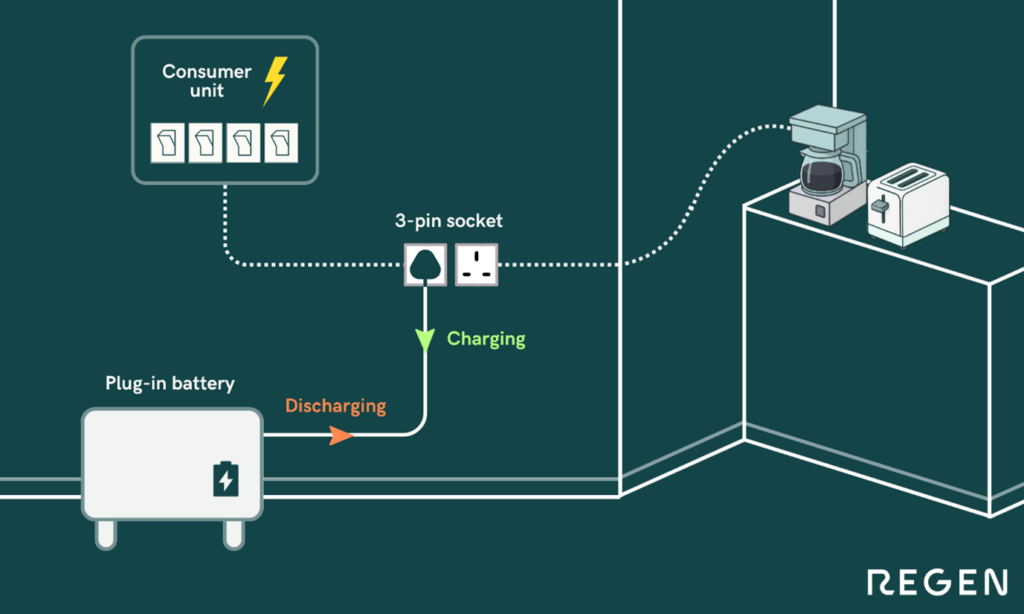
A plug-in battery is a portable energy storage unit that can be plugged into a standard wall socket without any modification to the household wiring. It charges by drawing electricity through the socket – typically during the off-peak period of a time-of-use tariff – and discharges back through the same socket to offset household demand at times when electricity is more expensive.
Unlike traditional domestic battery systems, which must be hardwired into the home’s electrical system by a qualified electrician, plug-in batteries can be bought off the shelf and plugged into a wall socket like any other household appliance:
Please read the entire article, but here’s the Regen team’s conclusion:
It’s clear that plug-in batteries could be transformational for households in Great Britain that to date have been excluded from the benefits of home batteries. It’s positive that the government has announced plug-in solar, but it has left plug-in batteries in a grey area.
Regen suggests that DESNZ should now:
● Commit to a date by which plug-in batteries will be legally available for use in Great Britain
● Commission a rapid safety study for plug-in batteries, and work with the IET and BSI to update BS 7671 (the UK wiring regulations) accordingly
● Sponsor a new product safety standard through BSI for battery fire safety in portable in-home devices (distinct from the PAS 63100 framework written for installed systems).
With the government commitment to cutting £300 from household energy bills looking increasingly out of reach, introducing a new product to the market that delivers meaningful bill savings at no cost to the Treasury should be one of the easier calls to make.
Hear, hear!